
Lords of the Fallen Review - Trying & Trying Again
From Software‘s Souls series, particularly Dark Souls 1 & 2, have changed gaming in more ways than even the developers could have imagined. Whether one likes it or not, its success stirred a radical shift away from the spoonfed gaming we were almost accustomed to, one that is now leaking even in AAA mainstream games, which are now proud to announce that gamers won’t have it easy.
Despite this, five years after the release of Demon’s Souls on PlayStation 3, no one has ever challenged From Software on its own ground before Lords of the Fallen. For this alone, Deck13 and CI Games could be lauded, although luckily there’s a lot more to praise about the game than just their courage.
Make no mistake, if you’re not used to the Souls games, you’ll need to brace yourself. As good as Middle-earth: Shadow of Mordor is, Talion is basically a demigod in power compared to his enemies; in Lords of the Fallen, Harkyn is merely a match for the Rhogar invaders, and even so only in the right hands.
That’s right, because this game requires your complete attention if you want to move forward at all. Each and every enemy can be deadly to Harkyn in its own way, which means that it’s literally vital to learn not only every attack pattern, but even the duration of these attacks in order to properly time your dodge/block/attack moves. A single mistake can translate in a significant setback in terms of progression, though not nearly as much as in From Software’s games.
There are waypoints scattered through the game world, and Harkyn respawns upon death at the last activated one. As you move towards your current objective, you’ll be extremely eager to find the next one, and not just to save your progress; of the two major innovations in Lords of the Fallen, one is strictly linked to waypoints. You can level up in these places (not to mention refill your health and potions, which is a godsend) by “redeeming” your experience points into either Spell Points or Attribute Points; however, the more experience you carry upon yourself while fighting the Rhogar, the higher the chance of finding quality loot. What will you do?
The other innovation is related to death itself. As in Demon/Dark Souls, you’ll lose the experience once dead and will only be able to gain it back on the very spot where you fell to the ground; however, being near his “ghost” gives Harkyn a series of buffs, including health regeneration. This can be extremely helpful in certain situations, but you should know that if you don’t claim the spirit in time, either because it expires (it has a duration) or because you die again before doing it, that experience will be now permanently lost. Once again, it’s a gamble and this is certainly a fitting concept for such a game.
The combat system is well done on all accounts, and proper RPG elements have been nicely embedded into it. There is an evident flow to fighting, with different combinations of fast and charged attacks yielding very different results based on the weapon used; interestingly, in Lords of the Fallen damage isn’t always king.
I remember having to switch my new, shiny Flaming Staff for one which deals a lot less damage because it was paramount to get quickly in and out of a particular boss melee range, and the staff was simply too slow to allow that. It’s just a glimpse into the many RPG-heavy evaluations that the game requires you to do over the course of the adventure; some encounters may prompt you to completely rethink your character’s build, and the rune system plays a large part into this. Depending on the situation, you can change playstyle to be more defensive or offensive, not to mention that there are useful runes to protect Harkyn against specific magic elements such as fire and lightning, for example.
It doesn’t matter how big a foe is if it’s not a threat to the player. I wish more developers heeded this advice, and Lords of the Fallen certainly avoids this pitfall with grace, helping the player respect his/her enemies. Of course, you’ll curse and swear when dying in a particularly bothering moment, but this is the path where the initiates tread - the path from frustration to exaltation. Lords of the Fallen has both in spades, but the former is mostly concentrated in the beginning, while still being accustomed to the harsh monastery infested by Rhogar; once the ropes have been learned, Harkyn also becomes more powerful and with more tools at his disposal, it is finally the time for glory after many defeats.
You’ll still die again and again, but as Dante Alighieri himself stated, trying and trying again is the key. Lords of the Fallen has some of the most thrilling boss fights in recent gaming memory, and the sheer satisfaction to bring them down after fights that may well last fifteen (or more) minutes is simply unavailable in most other games.
That’s not to say Lords of the Fallen is without faults, though. The few characters with whom you’ll interact aren’t really interesting, and even Harkyn isn’t much better, which may be due to the mediocre voice acting and motion capture; while there’s an intriguing underlying concept to the plot, it’s just too rough to be appreciated. The dialogue system is quite basic and there aren’t many choices at all.
As a whole, the game is thinner on content than Demon/Dark Souls and there’s no multiplayer, though it still sits between 25 and 30 hours and that’s not even considering all of the sidequests.
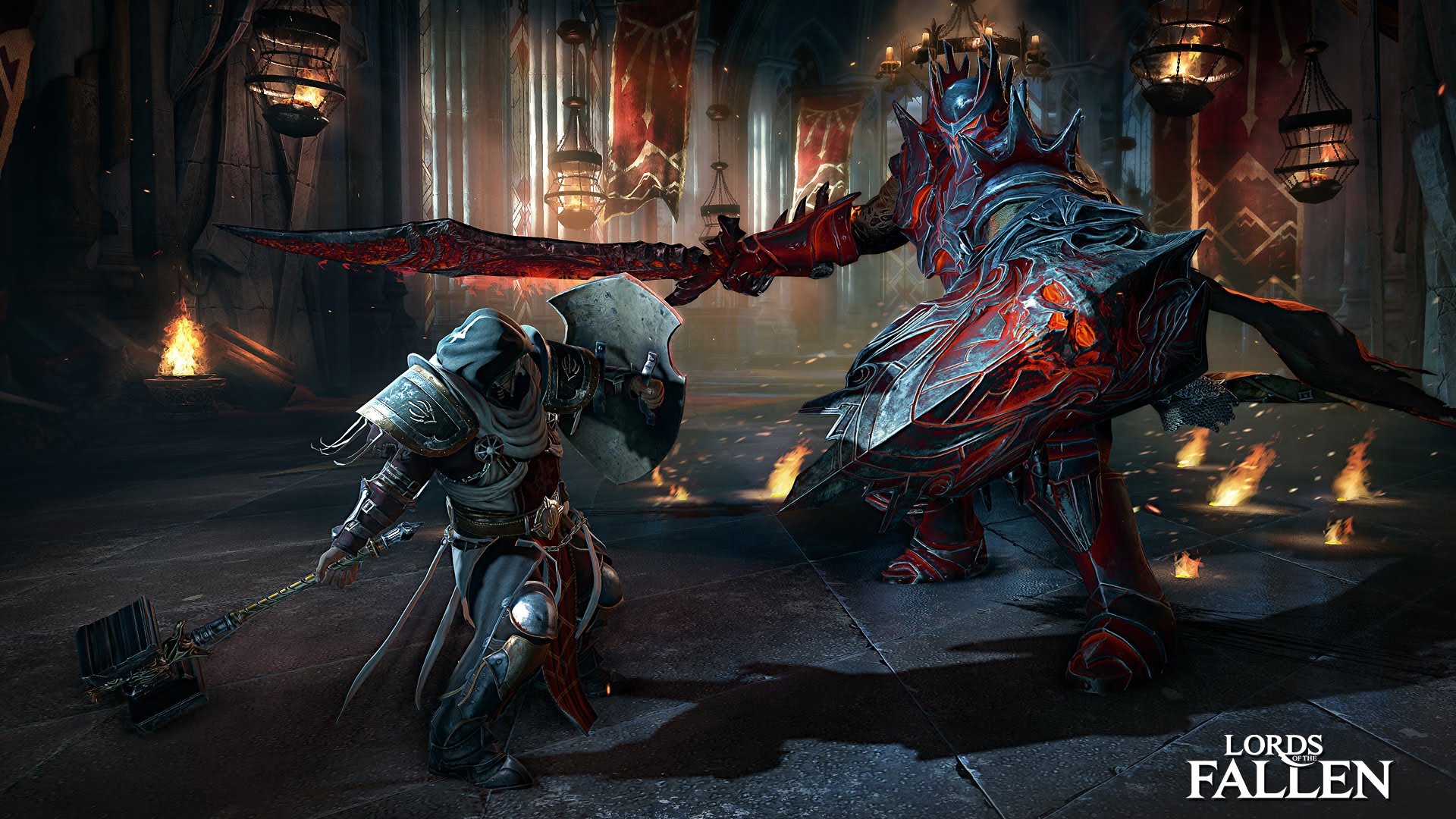
With the script lacking, the whole immersion factor in Lords of the Fallen is squarely upon the shoulders of graphics. Fortunately, these are very capable shoulders: the game’s FLEDGE engine (which was one of the topics of our interview with developer Michele Giacalone) provides spectacular looking environments and characters. Everything from weapons to armors is rendered beautifully, but perhaps the most striking graphics features are particles and physics, both built upon NVIDIA‘s APEX framework.
Overall, while it doesn’t quite reach the heights of Ryse: Son of Rome, it comes surprisingly close; however, all this splendor takes its toll.
With an i5 2500K and a GTX 780Ti, maxed settings@1920×1200 are often smooth, but not always, with some pesky stuttering showing its face more often than not. I’ve just installed an i7 3770, though, and immediately noticed improvements on this front; regardless, you’ll need a beefy configuration to enjoy Lords of the Fallen at its fullest. Unfortunately, there also seems to be an issue with the latest NVIDIA Game Ready Driver 344.48 (supposedly optimized for this game…) which makes Lords of the Fallen crash quite a lot. During my playthrough, I experienced about 15-20 crashes, a couple of which during boss fights - you can figure out my reaction at the time. Needless to say, hopefully this will be resolved soon.
I was also able to try the game on PlayStation 4 and the difference in favor of the PC version is noticeable, though it’s still a beautiful game on Sony’s console. Frame rate seems to be around 30FPS, but it definitely drops below in some occasions.