
LotF Dev Talks About Tech, PC & Consoles
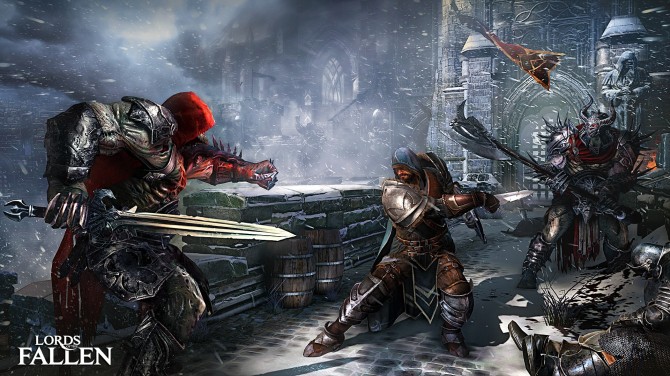
We’ve teased you quite a bit with our previous snippets, but it was kind of necessary as you’ll notice today, since our full interview with Deck13‘s Michele Giacalone is really huge! We touched many topics in our conversation, starting with Lords of the Fallen (LotF from now on) and moving onto the hottest technology debates, from DirectX 12 & Mantle to consoles and even complex development techniques such as Asynchronous Compute, Physically Based Rendering and Voxel Global Illumination. Enjoy, and remember that the game (which I loved at Gamescom) comes out next week
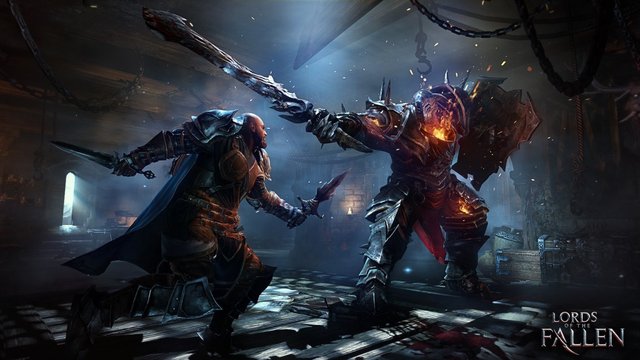
- You’ve built a in-house engine called FLEDGE for Lords of the Fallen. Can you tell us why you decided to do this instead of just using a third party engine such as Unreal Engine 4 or CryEngine?
We have been using our engine in the past for several other projects, such as Venetica, and we continued to extend and improve it for each new project we had building over the time a technology and a set of tools that matches closely the needs of our team. Using a third party engine, especially for large projects, may not be an ideal solution, especially if the whole team has to switch to a completely new workflow and there are still big technical questions on consoles performance. For us it was more convenient invest in our own technology, it required a lot of efforts, but it paid out in the end.
- What’s the single feature of FLEDGE you’re most proud of? Also, would it be possible to create a seamless open world RPG with it, or would it be necessary to make a lot of changes?
It’s hard to answer to this question, I am proud of many aspects of our engine, but probably one of the best feature that can be appreciated in LotF is the volumetric lighting system. Our engine doesn’t support any complex streaming features yet, so a seamless open world would have been really difficult to achieve, but this is one of the aspects we are investing time and research for the next engine iteration.
- I’ve read from your technical slide presentation that Lords of the Fallen started as a PlayStation 3 and Xbox 360 game. Was it challenging to switch to next generation hardware during development? Also, would LotF be possible at all in its final incarnation on PS3/X360?
Switching to next generation was one of the biggest challenge for this project. We had to find our definition of next generation in term of visual quality and scene complexity with basically no experience with the new hardware. This was a crucial phase because we had to base on that the new guidelines for artists and designers, affecting the whole content creation process. The more we progressed with porting our engine to the new consoles, the better we could adjust those guidelines trying to find the right balance of visual quality, scene richness and performance. Moreover, in order to achieve the best performance on the new hardware we decided to not maintain back compatibility with DirectX 9 and previous generation consoles. For example we dropped completely our deferred lighting renderer - necessary on the Xbox 360 - in favour of a full deferred rendering approach saving a nice amount of time in draw calls. Getting back to the question, we couldn’t have achieved such result on the previous generation hardware.
- During Gamescom 2013’s presentation, I asked Jan (Klose) and Tomasz (Gop) about the impressive lighting and physics and they told me the game used PhysX, although the final version would probably use a combination of different libraries. Are you using any NVIDIA GameWorks effects at all for the PC version, such as HBAO+, TXAA, PCSS, Turbulence, PhysX Particles/Destruction/Clothing, HairWorks? Also, are there any DX11 exclusive effects on PC?
We are using a lot of APEX features for LotF, nearly every character uses clothing and there are tons of destructible objects and particles as well. We already had some of the technical solutions NVIDIA GameWorks offers, we optimized them for consoles and reused them across all the platforms we support, including PC. Most of the graphics features in our engine, especially lighting and post processing, requires DirectX 11 Compute Shaders.
- I’ve praised the game’s graphics in my previous articles, at least for the PC version (which is the only one I’ve seen so far). Will there be any difference in terms of texture resolution and/or effects with the PS4 & XB1 versions? ****Also, what kind of configuration do you reckon will be needed to run the game at 1080P@60FPS with every setting maxed?****
There won’t be any substantial difference in graphics effects across the platforms, and texture quality will be the same on both consoles. Regarding the resolution, PS4 will ship at 1080p while Xbox One at 900p.
- You’re surely aware of the push for lower level APIs made initially by AMD with Mantle and then by Microsoft with the upcoming DirectX 12. Did you evaluate adopting Mantle for Lords of the Fallen? Moreover, do you think Mantle & DirectX 12 will truly enable developers to squeeze more power out of PC hardware?
I will be honest here, I think Mantle or low level API in general are quite complex concepts to grasp, especially without a technical background. A low level API is basically some kind of simple set of functionality that maps closely to the hardware allowing developers to unlock extra performance that wouldn’t be possible using high level API such as DirectX 11. This comes in cost of extra effort from the developers because they have to take into account more things that are not handled automatically anymore. This is what you usually do on consoles, so this isn’t a new concept at all, it just has gained audience after Mantle went public. Honestly I won’t bet on Mantle right now, mainly due to its platform restrictions, but on the other hand I really appreciate the direction they have marked for the future of graphics API for PC platforms. DirectX 12 will be surely a way to achieve better performance on PC platforms, but don’t see it like a magic wand, it will take time and a lot of efforts before developers can squeeze the maximum power out of it.
- You have worked on both PlayStation 4 & Xbox One for this game. There appears to be an ongoing debate among developers, with some saying that these new consoles have a lot of power and will produce amazing games with fantastic graphics over the years, while others have stated that Sony & Microsoft created “budget” hardware that is already surpassed by PCs. What’s your assessment in this regard? Do you believe we’ll have noticeable improvements in console games in the next few years?
As I said before, developers have better API on console to achieve best performance, so you can’t compare directly performance on a similar PC configuration. I believe that both consoles have decent hardware capable of great visuals and rich contents, and exactly as every console generation, developers are going to push the hardware to the limit.
- Speaking of the future of development, many teams have stated that there could be massive performance gains by using Compute, especially on PlayStation 4. Do you agree with this? Will you switch to Async Compute as well whenever possible?
Asynchronous Compute is not a new console bound technology, titles using Mantle can take advantage of the powerful AMD GCN architecture as well, and this is surely one of the most interesting aspects to dig into. Our engine supports heavy compute based features, such as particles, hair and grass simulation. We didn’t manage to use them for this project due to time constraints but those are a great starting point for us to experiment with async computes. We also started to redesign our render process to completely hide the cost of some expensive passes. I am expecting great improvements going in this direction.
- I’ve read on the slides that you couldn’t implement Physically Based Rendering in Lords of the Fallen but you already have a PBR renderpath ready. Is PBR really the future for all kinds of games, or do you think some genres might be better off without it?
We didn’t switch to PBR because it takes very long for artists to fully adapt to the new workflow and we simply didn’t had that time. PBR is a great tool to achieve great and consistent visuals, it has a simple way to author materials and allows a massive reuse of materials with completely different light conditions. Anyway, I believe PBR itself is not the only key to achieve great visuals. In my opinion, what makes a game look good is the ability of the team to use the tools they have. It is really important to give artists the level of flexibility they need to express themself as much as they can. We are already moving toward this direction, trying to use PBR in a way that can be bent in some aspects to fit the art direction requirements.
- NVIDIA recently presented their Voxel Global Illumination (VXGI) technology. What do you think about it? Is it a viable and efficient solution for Global Illumination, which is kind of the holy grail in graphics tech?
The Voxel Cone Tracing is a really interesting algorithm to achieve realistic GI, and it works amazingly well for indirect specular lighting. It is worth noting that this is not a new technology, it has been first introduced by Cyril Crassin in 2011, and one of the first implementation can be seen in the Unreal Engine 4 Elemental Demo. VXGI is a greatly optimized solution for GI based on this technique that makes advantage of the new powerful Maxwell architecture, speeding up even further the voxelization phase. Even though using this technology you can achieve amazing GI results, I am still convinced that the GI approach to use really depends on the game’s look. If you are making a game where reflections are one of the main visual feedback, VXGI would be a perfect candidate to achieve such realism, but in other cases a simpler solution may look great as well. Anyway, I really like the tech behind this technique, I will follow with interest any update in this direction.
- Thank you for your time.