
Elite Dangerous Review
With great learning curve comes great responsibility. Or something like that. When you start Elite Dangerous, you’ll be swept away into an ocean of menus, space stations and stars, but if you cling to the life raft of your ship for long enough you’ll learn how to navigate the terrors and wonders of the Milky Way.
This is not an easy game, as evidenced by the tutorial system recommending to watch video guides prior to even attempting the control of your ship. Between travelling, trading and mining, you’ll spend hours watching tutorials before you finally feel like a master of the stars, able to turn your hand to anything. Like so many other games these days, Elite Dangerous is free-form, your game is your own. Do you want to be a pirate? Be a pirate. Do you want to eke out a living on the every frontier of humanity? Go for it. Do you want to recreate Firefly as best you can? Get gorram going then.
But before you can start making a name for yourself, you’ll have to learn how. Elite Dangerous has complex ships controls, a terrifyingly realised economy, and more stars then you can count. Just taking off from your starting station can be a tremendous struggle. Jump to the next system requires a keen understanding of your ship, and may or may not end with you barrelling into a neighbouring star. But as you begin to master the game’s unforgiving mechanics, you’ll get a sense of pride normally available only in titles like Dark Souls. A smooth landing can make you feel a hero, while an epic voyage inspires a sense of pioneer spirit that is hard to find anywhere else.
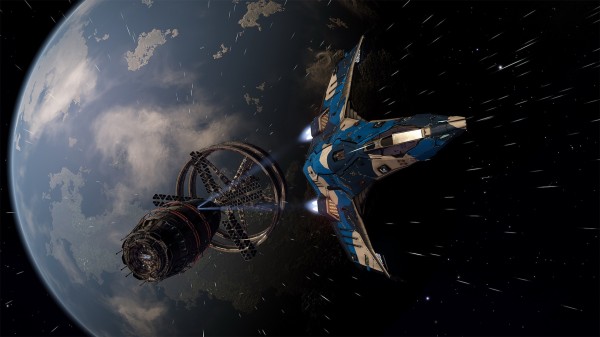
Impressively, Elite Dangerous is filled with so many little extras that makes the world so much more than just empty space. The sky box surrounding each system changes depending on where you on the galaxy, to correctly display what it would look like from that point in space. The space stations, slowly rotating in deep space, spin just to recreate Earth-like artificial gravity for its inhabitants.
What’s truly strange about Elite Dangerous however, is why its so fun. Once you get into a grove of cruising between stars making money however you choose, you’ll start to notice the lack of gameplay it actually requires. A lot of the game is merely lining up your ship and flying in a straight line. It might not sound fun, but I found myself happily spending hours coasting to the next space station. However unexciting you might think it is, Elite Dangerous’ inheret sense of satisfaction keeps players hooked somehow.
As goals in Elite Dangerous are set by the player, they can be quite distant ambitions, and will nearly always revolve around credits. Being the currency of the galaxy, credits can be earned in four distinct ways and are used for everything. Trading, Mining, Bounties and Exploration. Luckily the starting ship, The Sidewinder, is adapt at every form of income with a little tweaking, and its probably best to try your hand at all before deciding which to focus on.
Trading is the most obvious, and yet trickiest way of making money. With the aforementioned economy at play, theoretically one would be buying products for cheap in one system before selling them for a profit elsewhere; however, it’s more complicated than this because of the fluctuating demand. Finding a profitable trade route is temporary at best.
Mining means cutting into asteroids found in belts circling around stars and selling the minerals and metals at space stations. Again, more of a profit can be made by selling them away from the source, but this would always slow the time it takes to make money.
Exploring is the slowest way to make money, as the player scans unknown astronomical bodies before selling the information on. The problem with selling the information is that you have to be over twenty lightyears from the system to sell on its information.
Bounties are arguably the most exhilarating means to building a profit. Scouring the star system for other ships with bounties, hunters then engage in combat attempting to destroy the wanted ship, before collecting the bounty from a local space station. Of course there is also the illegal alternative to bounty hunting, piracy. This has the player hunt for cargo laydened ships before attacking them and stealing their cargo to sell on the black market.
Combat is indeed the most exciting part of Elite Dangerous, but the game’s MMO aspects mean that new players may be overwhelmed by pirates, accidental run ins with the law and other bounty hunters if they choose a life of crime.
Most of the combat is fairly similar to the aerial dog fights in games like Ace Combat or Battlefield. You’ll need to move in all directions to flank escape and overwhelm your opponent; it can be very intense, even more so when you’re fighting a combatant with a different and potentially lethal loadout.
Ships can be almost completely refitted in the game, with different engines, cargo holds and indeed weaponry. Finding a balance that suits your personal playstyle is essential as combat can be over extremely quickly if you get overpowered. And whatever policy best suits your sensibilities you’ll need go weapons and a decent understanding of combat. NPC pirates and other players will attack without mercy.
Despite its MMO elements, interaction with other players is fairly limited right now in the game, not to mention that with the entirety of the Milky Way available to explore, finding another player is not always easy. Luckily when you do, a lot of players are friendly offering tips and advice in the chat box, but never trust them fully.
Elite Dangerous is a game filled with so much more than can be said in a review. And with its seemingly boring gameplay becoming almost addictive, it’s very difficult to explain why it feels so much fun. Whether you’re saving up for a new ship, or just travelling as far you can surrounded by the universe, there’s always something to do in Elite Dangerous, you just have to decide what.