

When seven years ago, it was 2006, 2K Games announced a new XCOM game, the entire gaming industry held its breath for a few moments, only to start weeping and crying when it was revealed that it would have been a shooter rather than a turn based strategy game in the vein of the original ones. For a few years this seemed to be the only XCOM game under development, until Firaxis Games (known for their work on Civilization franchise) was called to lead a new project, started back in 2008 and announced to the public in January 2012.
Obviously, I’m talking about XCOM: Enemy Unknown, which presents itself as both a remake and a reboot. Everything is back where it belongs, from the classic strategic gameplay to the alien invasion of Earth, in a mix which has been clearly adapted to modern gaming standards. Originally, the prototype was identical to UFO: Enemy Unknown, but then Firaxis decided to bring many changes to the formula after several revisions. Thanks to the Quality Assurance team, the gameplay has been smoothed significantly whilst retaining the key features that players are used to in a game set into XCOM world, like its acclaimed tactical focus.
Everything begins when some aliens of unknown origin, in a future not far from ours, suddenly invade Earth and start a series of human abductions. In retaliation, a council of the most powerful nations activates a super-secret project called, of course, XCOM. The project involves the best soldiers and scientists from each army and it has significant funding to develop the most advanced technologies needed for the fight.
Unfortunately, things are much more complicated in reality: funding is everything but unlimited and the safety of the soldiers on the field strictly depends on the tactical choices made during a mission. The game is effectively split in two different phases, the field we just mentioned and the underground base management, which requires a great deal of care; it will be very important to choose how to best expand the structure, seeing as that there are only so many slots and for example building a power generator on steam cells is highly recommended, because it will yield much more energy.
It’s right here, in the base, that the scientists of XCOM project are doing their best to fuel the war effort with all kinds of technologies, from weapons and armor to satellites and structures; this part enhances gameplay with a strong management flavour. It is not unusual to face difficult decisions: do we give priority to a substantial tech improvement which requires a few weeks to be developed, or should we prefer a lesser but quicker improvement?
Obviously, it’s up to the Commander to use the equipment in the best possible way to give soldiers the best chances. The team is entirely customizable through a specific menu, both aesthetically (you can even change their names and nationality) and in terms of their skills, which will develop due to their actions. Beware, though: death is permanent in XCOM: Enemy Unknown, and this single element adds a great deal of drama to every turn.
Not only the game is much better with it, but it also drives the player to care about every human resource, since they won’t be easily replaced. I strongly suggest to avoid the “save&load” loop by enabling the Ironman mode. In this mode the design choices pursued by Firaxis flourish to their finest, as every change is saved and the player is forced to deal with his/her losses and try to prevail against all the odds.
The strike missions against the aliens can be quite different. The story follows a series of standard scenarios in which to pursue certain goals to defeat the invasion; in the meantime, the Earth surveillance will continously generate missions in which the operatives team will have to avoid human abductions, alien invading territories or destroying cities.
These events occur simultaneously in multiple continents, therefore the player is often forced to make a choice and pick only one place to save; if the mission is successful, the alert meter will drop in this zone but it will inevitably rise in the other ones left to their own. The maps are quite varied, although there’s no trace of the random generation from the original XCOM, and their style is always fitting to the overall XCOM theme; their layout is clearly thought for tactical approaches, where flanking and ambushes quickly become the norm.
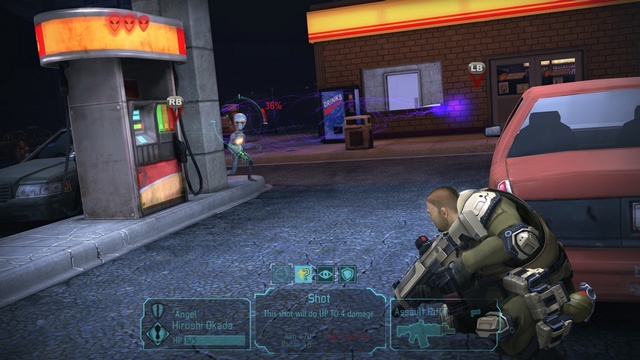
It’s in the gameplay that Enemy Unknown manages to set itself apart from the label of “boring turn based strategy game”. The camera constantly follows the battle flow, zooming in “over the shoulder” perspective to highlight critical moments; the interface is clean and helps to speed up things, making for an exciting pace.
All the tactical opportunities offered by the original are laying in the background, while the player impacts events by choosing the right weapon, the right position, the right cover and the right skills.
The remaining portion is handled by the enemy AI, which despite a certain a degree of predictability is still able to offer a challenge, even at Normal mode. A mission fulfilled without losses is therefore a thing for celebrations, and the subsequent satisfaction can be quite high.
Naturally, a good enemy must be not only skilled, but also capable of variation. In fact, the alien faction deploys several different types of enemies: the huge melee fighters, the humanoids who spit poison, the lethal robots, strange creatures with psychic powers and nasty insectoids, they are all featured.
Each one of them is designed with a style which seems a mix between something out of a comic book and a vision of the future which slightly reminds Fallout, with deformed character models and bright colors.
The graphics powerhouse behind XCOM: Enemy Unknown is the Unreal Engine 3. The resulting look is generally appealing, however I cannot forget to mention some shortcomings for the PlayStation 3 release, which sports significant texture pop-in. The code optimization is not great either, with the frame rate often below the optimal values for smooth gameplay.
Some glitches are also notable in player movements, but for those gamers who can afford to get the game on PC, I will recommend this version wholeheartedly, as none of these issues were felt during my gameplay over there.
Other than the extensive single player mode, XCOM: Enemy Unknown also debuts a 1-vs-1 multiplayer mode. The goal is simple, annihilating the enemy forces. The main difference with the campaign is the lack of progression between matches for the operatives; interestingly enough, players can choose their dream team from both human and alien armies pools. During the action, humans will gain points and be able to improve, but aliens cannot.
It’s a mode which certainly adds to the longevity of Firaxis’ product, although entirely disconnected from the campaign (other than the lack of progression, the base management section is missing as well).