
Crytek On Ryse, CRYENGINE, Graphics
We have teased you in the previous days, but here’s our full interview with Crytek and specifically, Nicolas Schulz and Brian Chambers. Obviously, we spoke about Ryse on PC (which released just a few days ago and we’ve reviewed here), but they were also open to other topics, such as their CRYENGINE and graphics as a whole going forward. Enjoy!
- Welcome to Worlds Factory! Can you describe yourself and your role in the team?
Nicolas Schulz: Thanks for having me! I’m Nicolas Schulz, and I’m currently working as a principal rendering engineer at Crytek’s Frankfurt headquarters. Over the past couple of years, I’ve enjoyed the opportunity to take a leading role in the rendering tech used for Ryse: Son of Rome on both PC and Xbox One.
Brian Chambers: I’m Brian Chambers, a Senior Producer at the Crytek Frankfurt studio. During my time here I’ve contributed to multiple projects, most recently working on Ryse: Son of Rome as a launch title for XBOXOne, and now bringing Ryse to PC in 4K.
- First of all, what kind of improvements are you bringing to Ryse PC over the Xbox One version from a technical standpoint, other than 4K support?
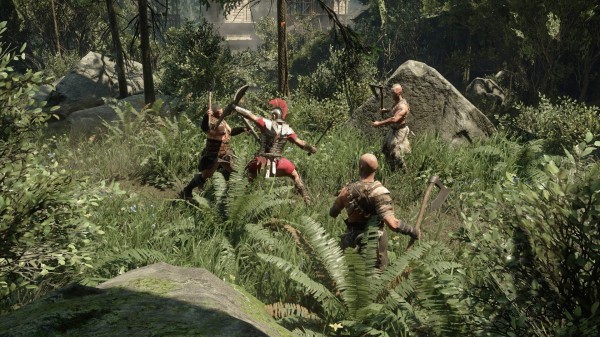
NS: On a capable system, players are free to choose if they rather prefer to run with high resolution (4K), increased framerate (60 FPS) or superior anti-aliasing quality (SSAA). For cases where SSAA is too expensive, we further enhanced our Temporal AA solution, resulting in a considerably more stable image. Object draw and LOD distances can be set higher, resulting in less popping, and we provide higher shadow quality settings, including smoother transitions between shadow cascades.
- In the PowerPoint presentation you recently published for Siggraph 2014 (speaking of, congratulations for taking the prize!), you mentioned among the rendering challenges the fact that the console hardware, specifically Xbox One, was already considerably less powerful than high-end PCs at launch. As a developer, do you feel that these next generation consoles are disappointing in terms of performance (and Xbox One even more so, having weaker specifications) as newly launched hardware? Could Ryse have been better looking and/or bigger if it was specifically made for PC, just like the first Crysis?
NS: Thanks for the congratulations! What is really great about the new consoles is that they have a modern GPU architecture and in contrast to the previous generation, a massive amount of memory available. Those two factors allow developers to apply some optimization techniques that would not have been possible before, effectively giving more power than what you have on paper. We had a certain vision regarding the visuals for the next generation and luckily we were still able to realize that on the console, we just had to take different approaches sometimes. For example, on PC we might have just relied on MSAA as an anti-aliasing solution but with the console limitations in mind, we focused our research on alternative techniques like Temporal AA. Our latest iteration of that works so well by now that we will likely continue using it even on more powerful platforms, so in the end this limitation had a very positive outcome.
- I know that in order to play Ryse PC@4K, an extremely powerful machine will be needed. However, what about 1080P@60FPS? Could an i5 2500K + GTX 780Ti be enough, or is a stronger CPU required?
BC: In a more general sense, I think PC players will be happy with just how customizable the experience is, and they’ll find settings that get the most out of their hardware and enable them to really enjoy Ryse on their own terms.
- The engines market seems to be very competitive at the moment, with Unity being popular among indie developers and many new Unreal Engine 4 titles being announced. Are you happy with where CRYENGINE is right now, and what kind of new tech features can we expect to see added in the future?
BC: There is certainly a healthy element of competition, although from our side we’ve always seen the engine business as being very competitive, and have always tried to take leaps forward regardless of what others are doing. We definitely feel CRYENGINE continues to push boundaries and make the most of available hardware, and the feedback we get from players and press seems to confirm that. Although I can’t go into specifics, we’re naturally hard at work on new features to keep CRYENGINE moving forward!
- You’ve won this year’s Siggraph award for Best Real-Time Graphics thanks to Ryse. Where do you see graphics going in the next few years? Do you believe there’s a chance we’ll see a massive improvement over Ryse as developers exploit everything out of PlayStation 4 & Xbox One?
NS: Going forward, I’m confident that some substantial visual improvements are possible and in fact we have a lot of ideas already how to further increase image quality. But of course visual fidelity is not just about technology. With its plenty of high-quality assets and fully performance-captured dialog scenes, Ryse has very high production values regarding its presentation. Achieving those does not only require a talented and passionate content team, it also comes at a considerable expense. We will have to see how many games can and want to afford that going forward.
- This will probably go unanswered, but it’s worth a try. Cevat Yerli told Eurogamer that Crytek can do whatever it wants with Ryse, since it’s your IP; many people are wondering, then, why the game isn’t being done for PlayStation 4 as well. Is there a chance to see the game on PS4 some time in the future?
BC: We’re always open to new opportunities for our franchises, although for the moment we have our focus firmly on bringing Ryse to PC players, as well as the ongoing development of our other IP’s: Warface, Arena of Fate and Hunt.
- Thank you for your time.