
The Tomorrow Children Uses Async Compute
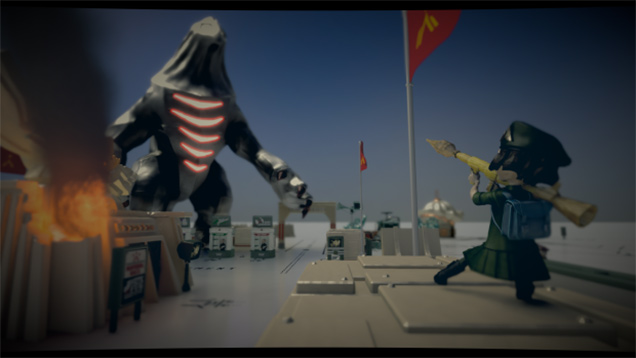
One of the most intriguing games to be unveiled during Sony’s Gamescom 2014 Press Conference was surely The Tomorrow Children by Q-Games. The art style looks unique and captivating, the setting is quite fresh (a Soviet Union post-apocalyptic dystopian world) and the game mechanics is reminiscent of a cooperative, but deeper version of Minecraft.
It seems like the studio behind PixelJunk is also pushing the boundaries of technology, however. In a presentation given to CEDEC by Director of Engine Technology James McLaren (and now available in PDF format), we learn that The Tomorrow Children’s devs have moved most of the Screen Space and Voxel Space to Compute, and McLaren declared this as a “massive win” when compared to just graphics pipe, adding that everyone should do this. In another PDF document, McLaren adds that they’ve used Async Compute “heavily through the project”, and concludes that “if you aren’t using Async Compute on PS4 yet, you SHOULD!”.
We have previously mentioned that many developers pointed out the importance of compute for PlayStation 4 games in the future, and this is another confirmation of the trend.
This is not all however, as the document explains in detail how they’re doing Cascaded Voxel Cone Tracing, an advanced technique useful to simulate ray tracing allowing realistic reflections instead of screen space reflections, which are used in most games.
In the slides, they cited the Unreal Engine 4 Elemental Demo as an inspiration.
Stay tuned on Worlds Factory for more on The Tomorrow Children, a PlayStation 4 exclusive with no release date yet (although a Closed Alpha test in Japan is scheduled for October).