Keeping a sports fan happy on a yearly basis brand isn’t a simple task. You have to know how to introduce significant innovations to mitigate the mistakes of the past and provide, in essence, a product that deserves to be purchased despite the fact that the core game is still the same from the last edition. Codemasters, since taking under its wing the lucrative F1 license, has always tried (with mixed results) to offer their fans a driving game that was tailored according to their needs.
It’s that time of the year again and I can already anticipate that F1 2013 is not a mere clone.
F1 2013 will be remembered primarily as the edition that introduced the “F1 Classics” mode. If last year the Challenge mode proved to be little more than a good diversion, this time “F1 Classics” is specifically designed to strike at the heart of those nostalgic fans who, at the very thought of being able to be one of the legendary figures of the Formula One on tracks that have made history, have a jolt to the heart.
You should slow your runaway enthusiasm, though. What the Classics mode will allow you to do is just competing in single races on board of a very small selection of cars and legendary drivers, even more restricted if you didn’t buy the Classic version of the game: if you decide to save money, you will be precluded to race with legendary drivers such as Damon Hill and Jean Alesi.
A commercial move that we don’t approve at all, primarily because this way, F1 Classics is a mode that remains empty and good only on paper, when it could have been (if fully developed) the spearhead of F1 2013. What should move us, then, to use dated cars for simple games without a more tangible goal? The sheer driving pleasure, of course, because if it is true that the skimpy number of drivers and cars let us down, as for the driving model it’s readily apparent that Codemasters has well played his aces. The cars and extreme roaring 70s and 80s, with their huge rear wheels and extreme aerodynamics, are a tribute to the mechanical perfection which must enhance the characteristics of a driver to take him to victory without interfering excessively on his driving style. The advice I’ll humbly give you is to remove any help provided by the game when you try this type of cars, because the resulting fun can be even higher than that yielded by the contemporary cars, too impregnated of electronics to let a pilot display his true skill.
What else we’ll find in this F1 2013 then? Everything that Codemasters has accustomed us in these last few years. The primary mode remains, therefore, Career, consisting of only five seasons and allowing you to play as a young driver just hired by one of the lower ranked teams with which you’ll have to reach that spotlight to get into a larger and more competitive team, hoping eventually to win the championship. Everything as expected and although the restriction to five seasons may seem like a huge issue, I found a sort of justification in the length of the seasons themselves: although I would have preferred to live in finer detail the career of a pilot from the beginning until the end of the career, I can perfectly understand the reasons that led Codemasters to opt for a different choice. Ultimately, this limitation shouldn’t affect gameplay in a negative way.
The track is and remains the most important test for any racing game and, in this respect, Codemasters does not disappoint; although, it doesn’t surprise either. The driving pattern, as already mentioned for the “retro” cars, is convincing, fulfilling, but especially scalable. Despite being in a perpetual limbo between simulation and arcade, without touching any of the two extremes, I must recognize that once all aids are deactivated, keeping the car on track can be a daunting task, especially if we’re gonna try with a pad, calibrated with a bad feeling , and not with a combo steering wheel/pedals.
You can’t, unfortunately, turn off the artificial deficiency of the opposing pilots. Despite showing some good driving skills, also underlined by the few who make mistakes when you will find yourself chasing, is when you will stand in the ribs that will show their dark side. You leave a small opening at the entrance to a curve? They attack you with prey firmly. You close them in the best way ? Not bad, they will crush you. This excessive aggression could also be fine, though remains a great defect, but things get different when the player continually gets penalties for accidents caused by others.
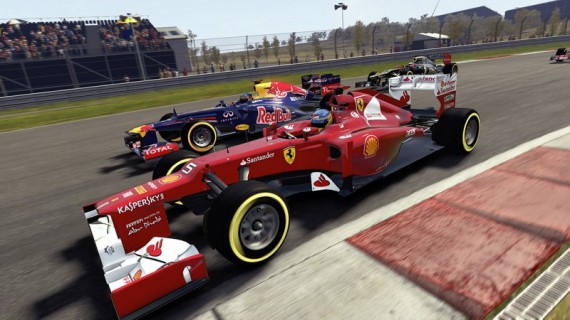
Another key point on which Codemasters relied for years is its graphics engine and the ability to adapt easily to any automotive context. F1 2013 is undoubtedly the jewel in the crown, technically speaking, among the Codemasters titles in recent years, especially if you play the PC version. Despite a graphic detail comparable to console versions (which is somewhat disappointing, given the extra power at disposal), it has a much higher framerate that helps to provide that gut feeling of speed which is a very important thing in an F1 game.
Polygonal models of cars are absolutely well made, but once on the track they seem like plastic toys: in short, F1 2013 lacks those aesthetic tricks that enable the creations of Turn 10 and Polyphony to look almost photorealistic. Absolutely top notch and well done, however, is the rain, which is emphasized by using the camera right above the cockpit. Aesthetic factors provided by the continuous downpour combine with the dynamic behavior of the track, which gets wet and dries dynamically during the race, making it a key variable for the race strategy.
F1 2013 is without a doubt a fine driving game, as well as a solid choice for the fans. The route taken by Codemasters is leading, year by year, to a more complete product and rich for the fans, but unfortunately without being able to shake off all the shortcomings of his predecessors which still remain in the code of the game, hopefully only until next year.