The chips will be built on Samsung's new 14-nanometer manufacturing process
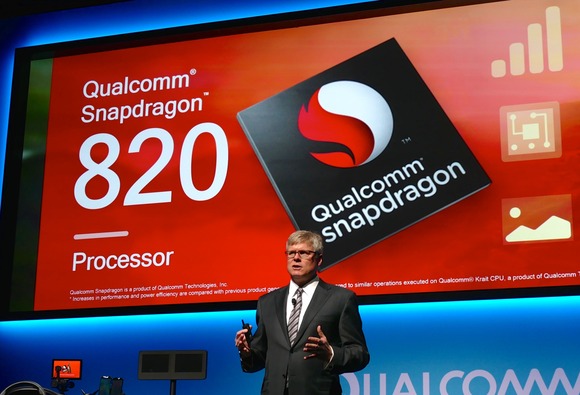
Qualcomm CEO Steve Mollenkopf talks up the Snapdragon 820 processor at CES in Las Vegas on Jan. 5, 2016
Credit: James Niccolai
Samsung Electronics will be making Qualcomm's upcoming Snapdragon 820 mobile processors, refueling speculation that the chips could find their way into the South Korean giant's premium smartphones, thus winning back lost business.
The chip-maker said Thursday it had begun mass production of logic chips utilizing its 14-nanometer LPP (Low-Power Plus) process, which is used to make its own Exynos 8 Octa processor. It added that the Qualcomm Snapdragon 820 processor also uses the 14nm LPP process and is expected to be in devices in the first half of this year.
Samsung and Qualcomm did not immediately comment on whether the Snapdragon processor would also be designed into Samsung's phones including the upcoming Galaxy S7. Leaks of the device, rumored to be announced at the Mobile World Congress in Barcelona next month, have suggested that it could use the Snapdragon 820.
A chip fabrication deal may not necessarily translate into Samsung using the Qualcomm chips in the Galaxy S7, said Patrick Moorhead, president and principal analyst at Moor Insights & Strategy. Samsung runs their businesses in a very disconnected fashion, with its mobile and semiconductor businesses very separate, wrote Moorhead in an email. "Therefore, I don't believe that the fact the 820 is built by Samsung increases its chances of being in the SGS7," he added.
Qualcomm lost business from Samsung as the smartphone vendor decided to use its in-house Exynos processor rather than the Snapdragon 810 chip in its flagship Samsung Galaxy S6 and S6 edge smartphones. Qualcomm said in April last year that it did not expect an immediate shift in its share of components in Samsung's premium devices and cut its revenue guidance for 2015.
But a shift could come because the 820 offers better performance than the Exynos. "I do believe Samsung must use the 820 to be more competitive with Apple. 820 hits performance per watt levels Exynos just can't hit," Moorhead said.
Smartphones and other devices built around chips made with the new process can also be expected to be more power-efficient and faster. Samsung claimed that its new 14nm LPP process delivers up to 15 percent higher speed and 15 percent less power consumption over the previous 14nm LPE (Low-Power Early) process through improvements in transistor structure and process optimization. Samsung announced in the first quarter of last year its Exynos 7 Octa processor built on the 14nm LPE process.
If you have (or plan to buy) one of Samsung's new Galaxy A smartphones, you should be happy to find out that the company is offering a set of exclusive UI themes for them.
Available for free via Samsung's Theme Store, the new themes (11 of them - for now) seem to have pretty simple designs, though that's not a bad thing. These themes only show up if you're visiting the Theme Store on a new Galaxy A smartphone, including the Galaxy A3 (2016), Galaxy A5 (2016), or Galaxy A7 (2016). At the moment, it's not clear if the themes also work on the Galaxy A9, but we assume that they do. After all, the A9 is newer than all other Galaxy A handsets.
As you may remember, Samsung started offering TouchWiz themes last year with the introduction of the Galaxy S6 and Galaxy S6 edge. It looks like plenty of users are appreciating Samsung's themes, as they can dramatically change the aspect of TouchWiz.
Samsung's Cheil Surges on Prospect of Publicis Stake Purchase - Bloomberg
Cheil Worldwide Inc., Samsung Group’s advertising agency, surged the most in more than two months on the prospect of Publicis Groupe SA taking a stake in the company.
The French company is weighing a bid for a controlling stake in Cheil, people with knowledge of the matter said this week. Cheil shares rose as much as 9.1 percent in Seoul trading, the most intraday since Oct. 21.
Publicis is considering a tender offer for about a 30 percent stake in Seoul-based Cheil Worldwide, which would make it the single largest shareholder, one of the people said. Any deal would probably see Samsung Group keep a significant holding in Cheil Worldwide, which had a market value of $1.9 billion before today’s trading, the person said, asking not to be identified as the information is private.
Publicis, which owns ad agencies including Leo Burnett and Saatchi & Saatchi, has struggled since a merger with Omnicom Group Inc. unraveled in May 2014. Last month, it lost most of the North American media business for Procter & Gamble Co., the world’s largest advertiser, as well as L’Oreal SA’s North American media planning and buying.
“Publicis has been distracted with acquisitions, while the main issue for them is defending and winning accounts,” Alex Wisch, an analyst with Bloomberg Intelligence, said by phone Wednesday. “It’s not the right timing or strategy at this stage.”
Consolidation Push
The French company wants to structure the potential transaction to ensure Cheil Worldwide continues handling Samsung Group advertising, according to the people. Samsung Electronics Co., the maker of Galaxy smartphones, spent 2.73 trillion won ($2.3 billion) on advertising globally in the nine months through September 2015, according to a regulatory filing, which didn’t specify which agencies the expenditure benefited.
The deliberations are at an early stage, and Paris-based Publicis may decide against making an offer, the people said.
Cementing Control
Samsung Electronics and engineering affiliate Samsung C&T Corp. own about 25 percent of Cheil Worldwide, according to data compiled by Bloomberg. Representatives for Publicis and Samsung Group declined to comment, while a spokeswoman for Cheil Worldwide said she’s not aware of the issue.
In September, Samsung Group completed a merger of its de-facto holding company Cheil Industries Inc. and Samsung C&T, with the merged entity keeping the Samsung C&T name. The deal helped the founding Lee family cement control by allowing the group to strengthen its cross-ownership structure since the merged affiliates had stakes in other companies.
Publicis unveiled a new management structure in December designed to drive revenue. That followed the company’s decision to cut its full-year sales forecast in October, saying it recorded no growth the month before as clients canceled and postponed campaigns.