
Middle-earth: Shadow of Mordor Review
After getting to play the game at Gamescom in August, I must admit I was both eager and anxious for the release of Middle-earth: Shadow of Mordor. My first impression had been great and I went as far as saying that it could be the sleeper hit of the year, but there was also the rationally sound chance that a system like the one Monolith called Nemesis could turn out to be a failure; it certainly wasn’t the first time that we heard something like that, but no game truly delivered until now.
I’m doubly glad to say that Middle-earth: Shadow of Mordor is the furthest thing from a disappointment, and the Nemesis System is perhaps the most revolutionary gameplay/AI system we’ve seen in AAA titles in recent years. While it is not perfect (I’ll get into that later), it truly enables a more dynamic and engaging interaction with our main character’s foes, making for some memorable gameplay moments.
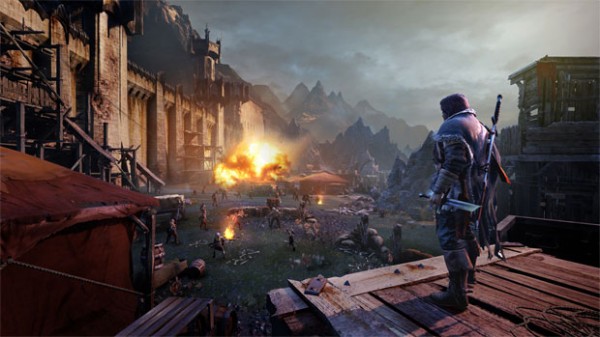
The game begins with Talion, a human Ranger of Gondor stationed at the Black Gate outpost in Mordor, being slaughtered along with his wife and son by the Black Captains of Sauron. This sacrifice was a deliberate attempt to summon the spirit of Celebrimbor, the legendary Elf Prince who ruled Eregion and created the Rings of Power after being deceived by Sauron; however, Celebrimbor ultimately merges with Talion instead of the Black Hand of Sauron, sensing the human’s need for revenge after the death of his wife and son, which is the same that happened to Celebrimbor.
Thus begins their quest, both of them bound by undeath and determined to strike back at the Dark Lord. However, Sauron has been preparing two full armies of Uruk’hai, one for each of the Mordor regions featured in the game, Udûn and Núrn; this is where the Nemesis System kicks in. Most of the Orc army is composed of grunts, but there is an entire hierarchy of named Orcs from the Captain rank all the way to the Five Warchiefs, who answer directly to the Black Captains. Each one of these Orcs have randomly generated names, titles and strengths/weaknesses, though you will have to gather intel in order to learn them; this can be done either by forcing an Orc to give it up, or by freeing some of the human slaves who may know something about it.
It is highly recommended to go into battle with the knowledge of your enemy, as doing otherwise could occasionally prove disastrous. While riding a Caragor into battle is generally both satisfying and useful, for example, a certain Orc could become even more enraged and powerful after seeing the beast, or even slay it in a single blow if it has the Monster Slayer trait; others, though, will run away terrified and you will be able to let the beast have it for lunch in no time.
That’s just the tip of the iceberg when it comes to the Nemesis System, though. When meeting a named Orc there will always be a short (and usually funny) cutscene with the Uruk’hai making some contextually related comment; in the example above, with Talion riding a Caragor, it could say something along the lines of “You brought me some additional meat for lunch, how kind of you!”. Most foes will also attempt to flee if badly injured, and if they succeed they will bring up your previous encounter the next time they see you - especially if you’ve left them burned or scarred.
While for the most part Talion is stalking the Orcs, in Middle-earth: Shadow of Mordor sometimes the reverse can happen, with a few exceptionally resilient Orcs actively trying to kill Talion for the fame that it would grant them. Sometimes they can rush into the fray while you’re fighting some normal Orcs, and things can get quite messy for your character - even when you’re trying to kill a specific Captain or Warchief, you may have to face two or three more who show up during the fight, usually bringing forth their own followers. One of the most striking moments during my playthrough was when, after successfully killing my current target, I engaged another Captain in a stronghold full of Orcs; eventually my health was running low and I desperately tried to escape, but one of the smaller Orcs on watch finished me with a crossbow. I died, and the lowly Orc cheered for the upcoming promotion to Captain.
When Talion dies, some time will pass before he is regenerated to life. During this time, Sauron’s army will grow stronger as the Orc Captains recruit new followers and fight each other in “power struggles”; the game shows all of this on a chessboard-like menu, which is also useful to understand who are the bodyguards of a specific Warchief you’te targeting.
Once Celebrimbor grows in power and unlocks the ability to dominate Orcs (much like Saruman did, in fact branded Orcs get a hand painted on their face), whole new gameplay opportunities open. Branded Orcs will fight by Talion’s side, but more importantly Branded Captains can be very helpful in betraying and/or assassinating Warchiefs.
If you’re thinking that the game at this point might become too easy, rest assured that it’s not the case; while Talion unlocks new abilities and powers, his foes eventually get very hard to kill. This is also one of the flaws of the Nemesis System, as sometimes the random combination of traits can create an impossibly strong enemy with invulnerability to monsters, stealth attacks, ranged attacks and combat finishers, just as an example.
Another consistency issue is that, for some reason, Monolith decided to resurrect one of the Captains that Talion kills, which would effectively become the Nemesis; at this point, the Orc just keeps coming back for some time, trying to kill Talion again and again.
While this is cool in a way, it doesn’t make any sense from a lore standpoint, as unlike Talion Orcs have no way to resurrect.
Still, dwelling too much on those things would be like quibbling. The reality is that Middle-earth: Shadow of Mordor is a blast to play, thanks to both combat and traversal gameplay sections.
If you’ve played Batman Arkham or Assassin’s Creed, you will be at home here. These games clearly inspired Monolith, although the studio added a few tweaks of its own, such as Quick Time Events which are generally interesting and almost never frustrating. For instance, one of the first upgrades in the Wraith tree is called Elven Swiftness and allows you to gain a bonus to movement speed with a properly timed button press after vaulting over objects; mastering this alone makes the game much more enjoyable, as Talion truly becomes a deadly shadow in Mordor.
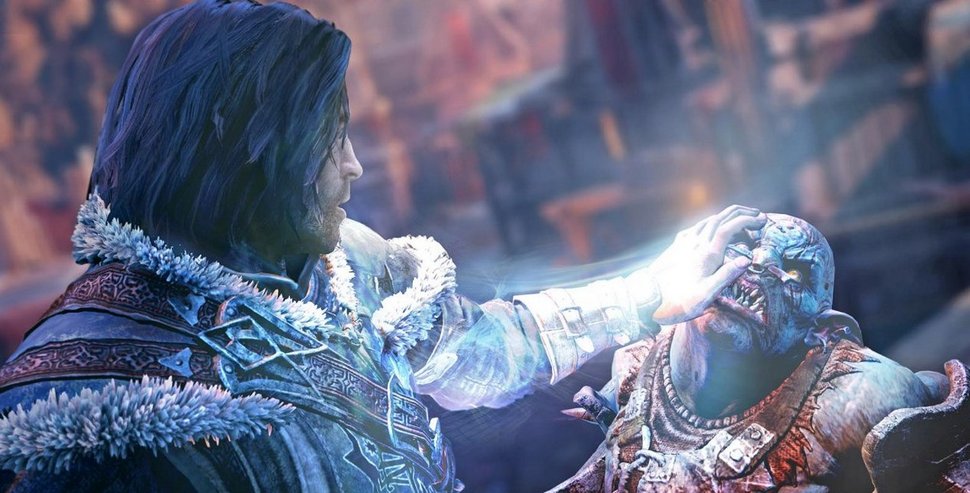
Fighting Orcs feels a lot like taking down thugs in Batman, although there are some unique perks here. Firstly, Batman never kills, as you all should know; Talion and Celebrimbor, on the other hand, are very much out for blood and this is reflected in game by an impressive quantity and quality of death animations, including lots of beheadings, which is very appropriate for an Orc killing machine such as the main character of this game. It is eminently pleasing to chop off the ugly head of a particularly nasty Orc Nemesis, I can attest to that.
There’s also some additional variation provided by the ranged and mounted combat options. Because of Celebrimbor’s Elven prowess with archery, you’ll be able to take out enemies from afar and interact with things such as beast cages, Morgai Flies nests and various explosives; interestingly, you’ll have to continuously check the environment to gather more arrows, much like with herbs which are the only item capable of restoring Talion’s health.
Perhaps even more exciting is the mounted combat. You’ll have to subdue a Caragor much like a wild horse before commanding it, but once you do, there’s a lot of fun waiting; the beast is fast and powerful, enabling you to ravage packs of Orcs with a certain ease and satisfaction. With a swift attack an Orc without shield falls down, ready to be eaten; you’ll have to do this very often, though, as the beast doesn’t have a lot of health and eating Orcs is the only way to gain it back.
Later in the game it’s also possible to ride a Graug (essentially, a massive Troll), although I found this to be less thrilling as it’s just too slow in both moving and swinging.
Another thing I liked in Middle-earth: Shadow of Mordor is that its game world feels quite alive. It’s not just the Nemesis System, with the AI very reactive to the surrounding events: for instance, Caragor packs (and Graugs) will attack both Orcs and Humans on sight, creating havoc. Humans usually run away once given the opportunity, but sometimes also gang up on a single Orc slaver to get their revenge.
The story in the game is well presented, thanks to excellent cutscenes and voiceover work (Talion is voiced by Troy Baker). The developers successfully captured the epic we’ve all seen in Peter Jackson‘s movies, especially in some missions; it’s a shame, then, that it ends quite abruptly, after two disappointing final boss fights. Still, length is not an issue as I completed the main quest and a few side missions in a little over twenty hours.
Graphically, Monolith did a great job with its own LithTech engine. The game looks awesome and more importantly, runs smoothly (unless you activate the Ultra texture setting, which requires a crazy 6GB VRAM amount for very little improvement) on PC. There are no bugs whatsoever that I could find, which is quite rare for a game with large maps and the ability to roam them freely; music is also very appropriate for the tone of the action and the setting.