
Sucker Punch: PS4 Future Is Compute; Explains Tricks

During GDC 2014, many developers presented their programming solutions to fellow colleagues; as usual, they also release the slides online for everyone to check out. This time the focus is on Sucker Punch, with the Infamous: Second Son postmortem just released on their official website. The presentation (originally given by Adam Bentley, Lead Engine Programmer) is quite long and can get very technical, but fortunately there are some straightforward bullet points for those less proficient.
The most interesting part is possibly where the talk switches to Compute. We know that many of the launch games didn’t even scratch the GPGPU possibilities of the PlayStation 4 hardware (for example, Killzone: Shadow Fall, as awesome looking as it was, didn’t really use compute), but at the same time, many developers believe that it will become the norm in the coming years.
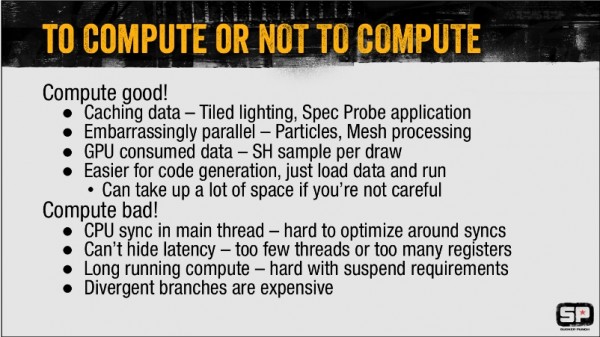
First of all, Sucker Punch makes it clear that compute is not a magic tool - there are some instances where it is good and other where it’s not so good, as exemplified in the above slide. Then, they actually give their fellow colleagues some specific PS4 advice in the form of the following tricks.
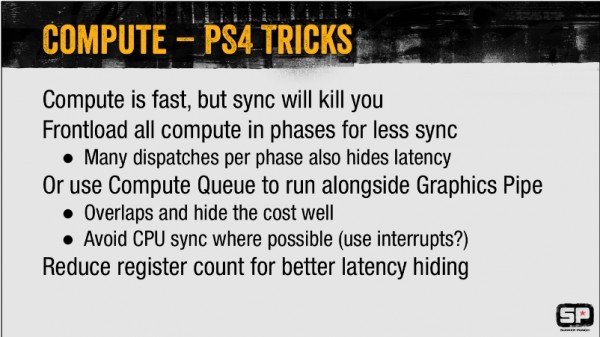
This slider’s comment, along with the next slide, makes it very clear that compute (along with “much more threading”) is the future:
Through a combinaton of code changes and compiler improvements, we were able to speed up our :led deferred pass by 75%. This is the power of registers. It will also matter a huge amount if you’re running in a compute queue. Too many resources and won’t be able to overlap with other execution.Compute queues are definitely the way of the future though.
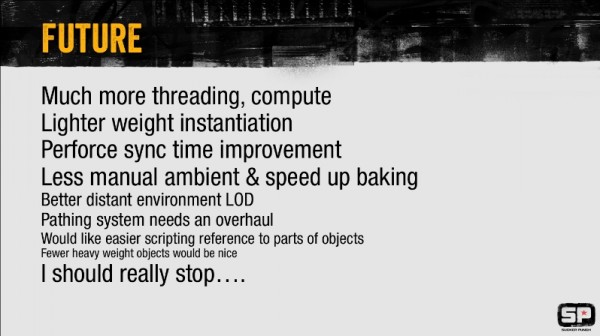 Some feared that with PS4 hardware being much closer than his predecessor to PCs, the platform’s graphics output would be maxed much sooner by developers. These slides, however, tell a very different story: even a first party studio like Sucker Punch learned many things after completing their first PS4 game, and according to what we’re seeing, there’s a whole different approach to the hardware with compute (or GPGPU - using the GPU for tasks that had traditionally been reserved for CPU) that many games haven’t even tried yet. What’s more important, it could prove the most fruitful.
Surely this (and more) information will be shared among first party studios at Sony Worldwide Studios, which only means that we’ll soon get to play even better looking games. Hopefully, Sony will show and/or announce a few of them during the next E3, which is less than a couple months away now.