
Aderyn’s Cradle Interview - CryEngine indie RPG
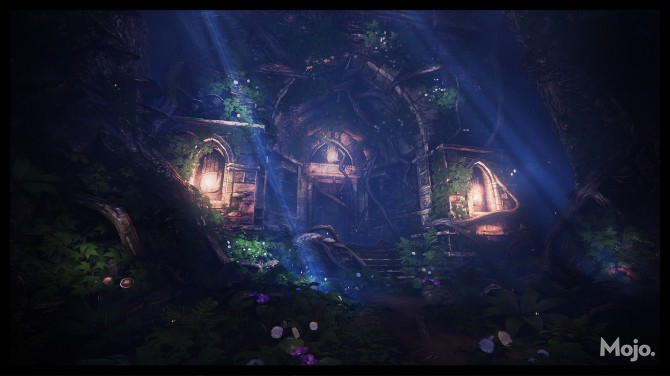
It’s been a while longer than usual since we’ve brought you an exclusive interview. Aderyn’s Cradle, however, should prove quite satisfying, especially for those of you who love RPGs, indie games and great graphics (powered by CryEngine). The team at Mojo Game Studios is trying to get funded through Kickstarter, though with 25 hours remaining as I write, it looks highly unlikely. Still, Mojo already has concrete plans in motion in the event of a failure and the game has potential, so I’m confident it will get released. Enjoy the read!
Q: Welcome to Worlds Factory! Please, introduce yourself and your game to our readers.
A: Hello all! I am Hank Zwally, President of Mojo Game Studios, and Lead Designer of Aderyn’s Cradle. Basically my job is to provide the high-level vision of the game and to design its in-game systems. I love gaming and always have. I started at age 2 when my mother put me on her lap and played the original Doom. I’m still indebted to her for all the explanation of what things did in games before I could even read! I have been gaming ever since.
Another founder and I came up with the concept for Cradle 2 years ago. I started Mojo about a year and a half ago to see that vision through, and the project has since been fleshed out and refined by our design team. Cradle is the game of my and my team’s dreams, and making it is also kind of making a dream come true. We’re all hardcore gamers, and have spent countless hours playing and thinking about games; this project is the culmination of what we’ve learned. It’s the fantasy adventure game we at Mojo, and hopefully all players, have been waiting for.
The game tells the story of an exiled traveler who stumbles into an ages old struggle between humanity, nature and the gods. Its an open world, fantasy adventure featuring five playable classes, four unique open worlds, and lots of deep gameplay systems, ranging from the augmentable weapons and armor to our Medica system which lets you craft healing items. We want the player to come away from Cradle with something memorable, we want it to be something that will leave a lasting impression on players.
Q: The premise of your game sounds quite intriguing. Can you tell us some of the inspirations for the storyline and lore of Cradle?
A: We drew a great deal of influence from ancient Celtic and Norse mythology when creating the culture and lore of Anora. Additionally, much of the combat culture portrayed in Aderyn’s Cradle is modeled after the melee weapon techniques of these two cultures; particularly the Druid’s staff fighting.
Our narrative is heavily influenced by the films of Hayao Miyazaki, specifically Princess Mononoke and Spirited Away for the way they deal with clashing human, natural, and mystic/spiritual forces.
Q: What kind of NPC interaction can players expect in the game?
A: Not many NPCs will be sentient. However, 4 NPC guides will aid your progression through the game. Scattered throughout the game will be other NPCs which you will interact with for quests, as well as storylines.
Q: Will it be possible to solve quests in non-conventional ways, such as persuasion, to avoid combat?
A: Yes, in certain scenarios.
Q: How much weight will the player choices factor in the progression of the story?
A: Player choice has a huge effect on how the game is experienced. Character progression is heavily linked to exploration, so players who prefer not to explore will end up weaker. However, your progression through the game occurs independently of your character progression, and we do not use a leveling system. In short, no, it is not possible to advance your character without exploration; but you do not need to progress your character to complete the story. Let’s say, for example, there is a powerful enemy to conquer in order to reach the next area. You can confront your enemy right then, compensating for your relative weakness with skill and some very well-planned moves. On the other hand, you can choose to back off, exploring the land and harnessing its resources. The more of the world you exploit, the more powerful you will become.
The same enemy you would have had to gruel through a punishing battle (and a few rounds of trial and error) with before, will be more easily overpowered. The choice is with the player.
To be clear, players also receive upgrades and rewards for progressing through the story alone, with no exploration. However, these yield only a bare-minimum power increase compared with what can be harnessed through exploration and side quests.
Q: Will Cradle have multiple endings based on the choices made during the game?
A: Possibly; we haven’t decided yet.
Q: Will the class choice factor in any way in the storyline, perhaps leading to different optional quests?
A: This too has yet to be decided.
 Q: Without giving too much away, what types of enemies can players expect to find in Cradle? A: The short answer is, all kinds! Anora has its own flora and fauna, and some of these are enemies. For example, an enemy we have on display right now at our Kickstarter page is the Swamp Stalker. This creature lives its life on four legs, so to fight it, you’ll have to strategize appropriately for fighting a quadruped. Thanks to the Realfight combat system used in Aderyn’s Cradle, those types of interesting nuances on the battlefield will be accessible to the player. There is a lot of room for interesting styles to develop based on everything from the weapon you choose to the terrain you fight in.
Q: Your “Realfight” combat system seems reminiscent, at least in its description, of games such as Chivalry: Medieval Warfare and Mount & Blade. What differences will players find when comparing Cradle to these games?
A: Cradle’s Realfight Combat System is a new way to fight, developed by Mojo Game Studios to bring the player an unprecedented level of dynamic control in first-person melee combat. Realfight brings four main tweaks to traditional first-person melee combat as it’s implemented in games such as Skyrim or Chivalry:
- Deterministic Combat Animations enable the player’s attacks to change based on which part of the enemy’s body is targeted. In other words, where you aim to attack on your opponent determines which attack your character executes. Because these choices vary by weapon, but are the same from enemy to enemy, this system is easy to learn and intuitive to use. Simply by aiming and clicking the left or right mouse button, you are able to choose in real time where and how you will strike.
- Order Determinism allows for smoother chaining of melee attacks; where you last struck has an effect on how the next attack will play out. If you have a sword and want to do a slash right at the torso of an opponent, followed directly by a slash left, simply aim at the right torso and click the right mouse button, then aim at the left torso and click the left mouse button. The result is a continuous slash to the right and back from the left. This system adds fluidity and reactivity to our combat.
- Weapons and weapon weight also factor into Cradle’s Realfight system. Each weapon is designed to have different strengths and weaknesses in combat, which is something not usually captured in first-person melee combat as far as their effects on blocking, dodging, or interrupting enemy attacks. For example, a player cannot successfully block a heavy mace with their own small dagger, nor could they hope to make a dent in a heavy shield using a short sword. The beauty of this system is that there is no restriction on the player from attempting these moves; but the fundamentals of the physics, momentum, and other aspects of real-life weaponry are present to build their intuition for what works, and what doesn’t; what to compensate for, and what to exploit.
- Proximity Determinism adds another layer of realism to this system. Essentially, when a player is too close to an opponent to accurately swing their weapon, they will push off from their enemy in order to reposition themselves on the battlefield. These push-offs will also be deterministic, according to where the player aims and which weapon they are using. What this improves upon, in traditional melee games, is the inconvenience of being unable to reposition without interrupting the flow of combat.
Q: Will there be a stealth option to deal with enemies?
A: Yes; in fact two of our five character classes, Arcanist and Ranger, employ a great deal of stealth as an integral part of their package. If you like stealth a lot, those two are probably good picks for you! The Arcanist rains hellfire on enemies from a distance, but at close range he uses his sword to cut down enemies. This class’s mage combat style is not unlike how Gandalf fights in The Lord of the Rings. This similarity is in keeping with the our use of the same Norse and Celtic influences that inspired almost all of Tolkein’s work. Being a mage, however, the Arcanist is vulnerable at close range, and employs stealth and diversionary tactics to compensate.
For the Ranger, stealth has a more offensive purpose rather than defensive. Stealth, when combined with the nimbleness of a Ranger, is used for surprise attacks and for finding optimal positioning to rain arrows on opponents from afar before launching into full combat. You could picture a combination of a ninja’s melee combat with archery and long-distance physical attacks.
For the other three classes, stealth is still an option, but not a central tool. Druids and Warriors can situationally use stealth to their advantage, while the Paladin will almost always fail these techniques.
Q: Also, with the dynamic weather, will stormy and cloudy conditions increase the chance of not being seen?
A: Yes, that is a feature we would like to have implemented in Aderyn’s Cradle.
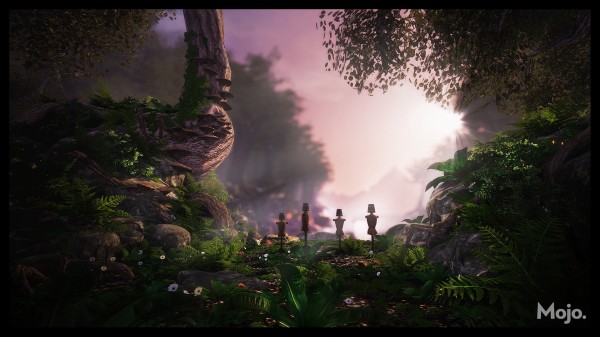
Q: On the Kickstarter campaign, you’ve made it clear that players will need to explore in order to craft “life-saving salves”. Does this mean that those who don’t care to do such things will find it very difficult to progress in the game?
A: Yes. Character progression is heavily linked to exploration, so players who prefer not to explore will end up far weaker. However, your progression through the game occurs independently of your character progression, and we do not use a leveling system. In short, no, it is not possible to advance your character without exploration; but you do not need to progress your character to win the game. Let’s say, for example, there is a powerful enemy to conquer in order to reach a new area in the story. You can confront your enemy right then, compensating for your weaknesses with skill and some very well-planned moves. On the other hand, you can choose to back off, exploring the land and harnessing its resources. The more of the world you exploit, the more powerful you will become. The same enemy you would have had to gruel through a punishing battle (and a few rounds of trial and error) with before, will be more easily overpowered. The choice is with the player.
Q: What’s your stance in regards to modding? It seems to me like this game could benefit a lot from it; Bethesda’s RPGs are virtually infinite due to player created mods.
A: Definitely! We’re not going go out of our way to make support for modding, but we will be sure to release a game that is moddable.
Q: You’ve said that you would like to expand on other platforms. Did you look closely at PlayStation 4 and Xbox One yet? Which one seems more appealing to you as a developer?
A: We haven’t looked closely at either yet.
Q: What happens if you are ultimately unable to reach the minimum funding goal on this Kickstarter campaign?
A: We produce more content, revise our approach, and launch again!
Thank you for your time!