
Carrie Review - The Horror of Growing Up
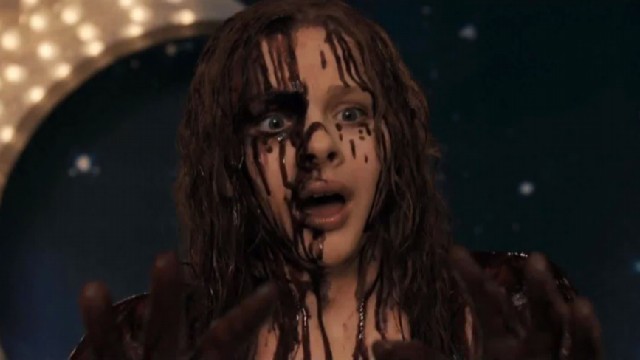
It was 1976 when Brian De Palma terrified the world with his movie version of Stephen King‘s renowned novel Carrie; the success was astonishing, and the film spawned an ugly sequel in 1999 (Katt Shea’s The Rage: Carrie 2) and an unimportant tv remake in 2002 (David Carson’s Carrie); even a famous Broadway musical was written by Lawrence D. Cohen, Dean Pitchford and Michael Gore in 1988. Given this, it’s no surprise that when MGM announced yet another remake back in 2011, the most common opinion expressed th total uselesseness of a new adaptation.
The story is quickly summed as follows: in a small town in Maine, Chamberlaine, a single, depressed and religious fundamentalist woman, Margaret, gives birth to an unwanted daughter, Carrie White. Just before killing her as a sacrifice to God, the woman decides to keep the baby. The girl grows up full of issues, and her mother’s folly badly influences every relation she tries to create with her peers. When, during her menarche, the usual bullies play a particularly hateful prank, something explodes in Carrie’s subconscious, and she finds out she possesses some superhuman powers…
The director of this new version of Carrie is Kimberly Peirce, author of Boys Don’t Cry and The L Word, while the script is written by Roberto Aguirre-Sacasa, fresh from his superheroical musical Spider-Man: Turn Off the Dark, and the influence of both is more than recognizable in the final cut. Aguirre-Sacasa sets all the story of Carrie and her discovery of telekinesis up as a superhero’s origin, borrowing more than a sequence from Marvel’s X-Men; Kimberly Pierce, on her side, reasserts the woman-only point of view of the story, to the point of turning the only two remotely positive male characters from the novel (Headmaster Morton and and Tommy Ross, respectively Barry Henley and Ansel Elgort) into total idiots, the first one portrayed as a coward incapable of taking up any position, the second as a light-hearted, dim-witted moron unable to do up his own shoes without the instructions of his girlfriend Sue (Gabriella Wilde).
Certainly positive is the judgment on Chloë Grace Moretz‘s performance: she creates a tormented, utterly shy, clumsy Carrie, a girl with her legs perpetually weaved and her eyes constantly to the floor. Julianne Moore‘s also did a great job at portraying Margaret White as a mad woman divided between bigotry and self-mutilation, guilty of a criminal education, but first of all victim of herself. Even for the two protagonists, however, Pierce’s direction becomes a problem: unable to balance actors and characters, she focuses all the attention on the only two stars of the movie, leaving in the background every other character, primary and secondary ones.
Even from a mere narrative point of view, the feminist re-reading of Carrie denies dynamism to its protagonist, and the girl’s nature, rebellious from the very beginning towards her mother, makes any further evolution unlikely and inexplicable. For a horror movie the boredom is far too much, and while De Palma built the suspense to have it explode in the final blood bath, you cannot feel any tension until the ball and the definitive manifestation of the girl’s powers (quite a dumb one: sometimes she’s powerful enough to break the pavement or to cause meteorite storms, some other times she’s too weak to repel her mother).
That’s quite a pity, since the movie had some potential, from the XXI century internet-based bullying to the (admittedly not rare anymore) image of a teenager’s body transforming into something alien and horrifying; even these cues, however, are drowned in rhethoric, with blood that supposedly represents the first blossoming, then rebirth and self-acceptance, then again rage and violence (a controlled rage, this time: being a truly rational and emancipated woman, Carrie doesn’t commit an unuseful carnage, but only punishes the “guilty” while sparing the “innocents”).
