
Battle Worlds: Kronos Review - Kickstarter done right
Battle Worlds: Kronos is a new addition in the now long line of Kickstarter successes. Where some of the games funded either fully or partly through KS have hit delays, gone above and beyond the projected budget and time scale, this comes even before the projected release date and with the quality and quantity that was promised. Battle Worlds: Kronos is also a new addition in the increasingly popular Turn-based strategy subgenre, and a very good addition at that.
The story of Battle Worlds: Kronos follows a race of humans that live on the neighboring planets of Kronos and Rhea who are fighting what is now the one-hundred and twentieth war of succession to decide who becomes the emperor of Kronos. It opens with the culmination of the previous war of succession which ended with the mass use of nuclear weapons while those who were rich enough left for Rhea.
This sets the campaign up nicely. Divided into thirteen missions, which come in two sections, the campaign follows the story through the war as you control or encounter either of the four playable factions. Three of the factions are part of the invaders, all parts of powerful groups that live on Rhea, while the other faction are the Residents who were left behind on Kronos.
Fighting here is, simply put, very satisfying. Each and every unit have been designed with loving detail and well thought out for improved tactical combat on the hex based grid. The tactical offerings come from the units being varied in their uses, being support units, ranged or direct attacking units. Other varieties come in the abilities offered. As an example, only Infantry units are capable of capturing an enemy building and only transport units are capable of transporting resources around the map (more on that later).
What further enhances the tactics is how the units are controlled, each being given two actions out of the three available. The three actions are either move, attack or joker. The Joker represents anything and everything, which means that a unit with two jokers has the possibility of either moving or attacking twice. Certain units can eventually replace the movement action with a joker action if the upgrade is selected when the unit levels up.
Where the hex grid truly shines, and the unit variety, is through the positioning of units. While it is common sense to put your heavy units to the front, ranged units to the back, the actual action of this is simple and satisfying. Especially so when using the terrain to your advantage, placing tanks in a pass between two wooded areas, rocket buggies and artillery behind them, with infantry flanking through the woods. The movement, flanking and range can be a joy to use.
Every combat throughout the game gains experience when fighting. Not only from destroying enemy units, but also simply by attacking enemies and being attacked by them. This does mean that level progression can be quite rapid if you can keep a unit alive long enough, giving you some exceptionally strong units further on in the campaign as units beyond a certain level can be carried on to the next mission.
What turns out to be the only true downside of combat is the lack of variety. The three invader factions all have the same units available to them, with the exception of a faction specific unit. The odd one out are the residents, who have a different set of units - with similar abilities to those of the invaders - but with a variety of downsides and upsides. The units for the invaders are based around superior technology while using as fewer men as possible, whereas the residents units are based around inferior technology, knowledge of the battleground and the guile to use anything and everything around them.
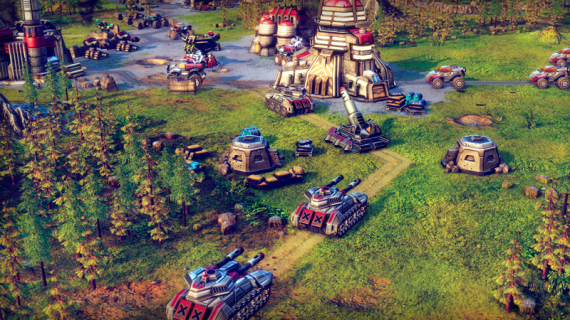
The differences are reflected initially in abilities and general strength. The army of the residents consists of a large percentage of infantry, from snipers to rocketmen and basic assault infantry. Resident vehicles are based mostly on refurbished old technology, such as using a reinforced pickup truck with a mortar on the back as mobile artillery. The invaders on the other hand have no actual human infantry at all, their sole infantry is a mechanized assault infantry and the majority of the army is mechanized, from light armored jeeps to heavy battle tanks.
Relying on people and basic technology puts the residents at a disadvantage of health but this disadvantage is countered by two quite sizable tactical advantages. As a vehicle is destroyed it can leave a wreckage behind, this wreckage can be used by the resident units to repair their vehicles. The other advantage is gained by the variety of infantry units, who can camouflage themselves in wooded areas.
Another slight niggling factor that can be found in combat is specific to the missions found in the campaign. The AI is decent, albeit slightly ham-handed in rushing towards you with no true formation beyond keeping ranged to the back. This is countered by the enemy in the campaign vastly outnumbering you, often four to one. What this means is you can, at times, find your tanks swarmed by a number of light jeeps with their tanks sat behind them, unable to get to you, taking fire from your artillery as their artillery attempt to pound through your tanks.
Not only settling to shine through having a fulfilling and an excellent combat system, KING Art has decided to make an exquisitely designed game. The visuals are bright and colorful for the most part, when zooming in everything from the units, building and landscapes are nice to look at. What can also be gained through zooming, but this time all the way out, is the base hex view showing a large piece of the map with the units, buildings and terrain represented by specific icons.
From the simple grasslands to frozen over rivers, there is a good variety of landscapes to see and fight through but the problem I’ve got, possibly from being spoiled by other strategy games of late, is that your actions have little impact on the world around you. You only impact the enemy units and buildings. Bridges, forests, even craters are all static and either for tactical use or for show. Your only impact that can be noticed later is the wreckage of an enemy or two.
Where KING Art seems to have settled is the UI. It feels that some functionality, or clarity, has been neglected to make it as unobtrusive, small and neat as possible. Moving between units, viewing different stats, leveling up and even fast forwarding through enemy turns are all possible, it’s just finding the correct method. Of course it is all possible if you pay attention to the tutorial when playing through it, but I tend to think most people are now like me and the text of tutorials become white noise as the next button is rapidly clicked to advance to the real game.
What I believe to be one of the core reasons for the UI limitations is the future of Battle Worlds: Kronos on tablet devices. Although it has been said that the future development of Kronos on a tablet wouldn’t result in any shortcomings with the PC development, it does act like that of a handheld strategy game with limits on the use of the keyboard and maximizing use of multiple button presses.
Where this future aim for tablets really comes to notice is for the multiplayer. At the moment the options are all there, either real time or asynchronous multiplayer, giving you a wealth of options when playing against people you know or don’t know. The current issue is that the multiplayer is a little broken. I’ve attempted to get in multiple games, 7 to be exact, within the past two days and I have only succeeded twice. One of the times the online game then seemingly stopped working for myself and the other player about twenty minutes in.
With a ironed out multiplayer system and cross platform play, with the future ability to swap between your PC when you’re at home and move onto your tablet when you’re on the way to work for the exact same game, the multiplayer has a huge potential. What will most certainly allow Battle Worlds: Kronos to reach its potential are future updates adding in more units, increasing the number and variety of maps and more content in general. This is already in the works with the ‘Trains DLC’ planned for release early next year.
You may also like...
80
Battle Worlds: Kronos is a very strong first showing in a different genre from the Adventure game developers KING Art. With brilliantly colorful visuals normally found in their adventure games, combined with a strong tactical system, albeit limited due to the small pool of units featured and the ham-handed approach by the AI.
The multiplayer has great potential when fixed and with the future promise of cross platform play. It is more than possible to recommend this even now, moreso when the first DLC is released early next year adding another campaign and more units for variety.
- Strong tactical combat
- Attractive and colorful visuals
- Strong campaign with a good length
- Lack of balance with AI
- Multiplayer barely functional (for now)
