
Bioware Strikes Back With Dragon Age: Inquisition
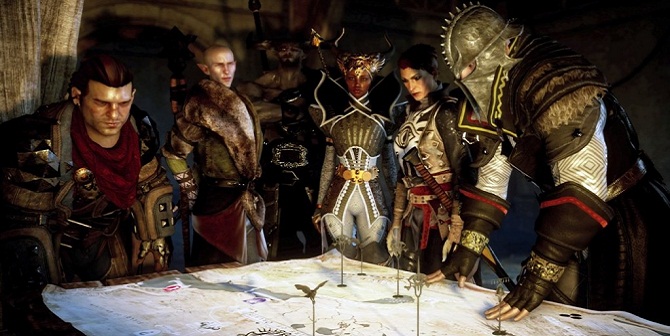
In the history of gaming, very few development studios have completely avoided any downfall, however small, over a very long period of time. It’s no wonder, then, that Bioware too fell into the trap at some point, after launching some of the most striking and successful RPGs ever such as Baldur’s Gate, Neverwinter Nights, Star Wars: Knights of the Old Republic, Jade Empire, Dragon Age: Origins and Mass Effect.
The first sign of Bioware’s crisis can be easily identified in Dragon Age II. Developed in just 14 months, it was considered a huge step backwards from Origins by many; just a few months after that, Star Wars: The Old Republic was released and it quickly fell short of the massive expectations (partly due to the huge budget, estimated around $150-200 millions). Even Mass Effect 3 was criticized by fans, mostly because of the endings.
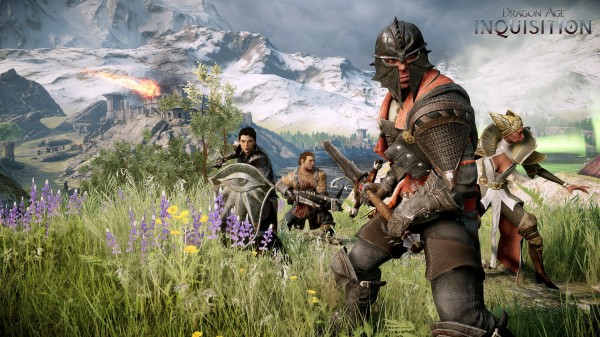
As a result, whereas Bioware had been a trademark of quality for many years past its foundation, gamers had become wary of their upcoming titles, starting with Dragon Age: Inquisition. It is only fitting that this is actually looking like a turning point for the company, now that a lot of information on the game has been released.
First of all, as the developers told us at Gamescom (we weren’t able to play ourselves, but we watched as some colleagues tried to banish evil from the lands), Dragon Age: Inquisition sits happily in the middle in terms of development time when compared to the first and second instalments; the first game took almost seven years to be made (probably because a whole fictional world had to be created), while this third one will have more than four years of work under its belt once it’s done.
The game was originally scheduled for release in 2013, but Electronic Arts delayed it in order to allow Bioware to apply more polish. From what we’ve seen, this was absolutely the right choice; the game looks stunning thanks to Frostbite 3, with big areas that will almost make you forget that this isn’t a full open world.
Bioware promised they’d merge the best elements of Dragon Age: Origins and its sequel into Inquisition, and the combat system is a clear example of this philosophy. You can choose at any moment to fight in action combat style (with a third person view), or you can pause time and issue commands to your party members (though only one command per party member can be issued at a time) from an overhead perspective, after pondering the best tactical option.
Following in the footsteps of many recent games, Dragon Age: Inquisition requires players to choose eight skills for each character to be used during a fight. There will be plenty of fighting, with 150 hours of content for just one playthrough, with the devs confirming that it won’t be possible to to experience everything without doing multiple playthroughs; of course, the story will be very important as well, with a total of twelve supporting NPCs (nine companions and three advisors) for the Inquisitor, the main character in this third chapter of the series. As usual for Bioware RPGs, the choices made during the game will majorly affect the outcome of the plot, with 40 ending variations confirmed (though only a few of them are completely unique); this time though, choice extends into gameplay as it will be possible to influence the environment to a degree.
For example, if the party kills many wolves in an area then their numbers will dwindle, and other animals will replace them. The same goes for plants, which will be quite important for crafting, touted as the deepest ever created by the studio. That’s not all though, as there will be an entirely new mechanic in Inquisition - the ability to capture & upgrade strongholds, which will unlock additional quests. It will be also possible to send your companions off to do specific missions, and they may or may not succeed.
Of course, it wouldn’t be a Bioware game if there wasn’t romance - you’ll have plenty of options to engage in a relationship with most of the companions, though they won’t be just like obedient pets. Party members may leave if their approval of the Inquisitor becomes too low, and you may find yourself with only one companion left if you drive the rest of them away, supposedly making the game much harder. You may even get betrayed, though I suppose that’s quite a hard feat to accomplish.
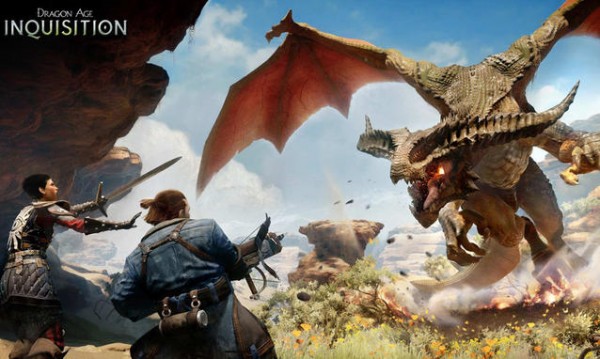
Of course, a game called Dragon Age just begs to show off dragons, and Inquisition is set to be the most accomplished chapter in this regard. There will be different types of dragons with variable features such as armor, breath attacks etc., though all of them will be carefully tuned (and optional) encounters, as opposed to random ones like in Skyrim. Being intelligent creatures, they will use both their own strengths - such as flying - and the environment to their advantage, setting fire to your potential cover; however, it’s possible to target specific limbs in order to force the dragon on the ground, thus making the fight much easier.
It should be noted that Bioware intends to follow through with their promise of importing world states from the previous games into Inquisition, thus allowing your choices to carry over in the new game. You won’t be importing your saves, though, as that proved to be more complicated than originally foreseen; Bioware decided to develop Dragon Age Keep instead, an application where players will be able to create world histories for Dragon Age Origins and II (including DLCs), to be imported into Inquisition. This isn’t mandatory by any means, as there is a default world state if you choose not to use Dragon Age Keep before starting your playthrough.
PC users could be a little disappointed to hear that no modding kit will be released, although this was expected after their choice of Frostbite 3 as the game’s engine. Truth to be told, the toolset released for Origins didn’t exactly create a lot of interesting content in the fashion of Elder Scrolls/Fallout titles, and there is a good replacement for extending longevity - the recently announced multiplayer mode.
Clearly following the unexpected success of Mass Effect 3′s multiplayer mode, the main difference is that this will be a more traditional dungeon crawling experience instead of an “Horde mode”. Three campaigns will be available at launch, set in Tevinter, an Orlesian Palace and some Elven Ruins; maps will be randomly generated in order to provide variation, with each session clocking around 20-30 minutes. Twelve characters, completely separate from the NPCs of the single player campaign, will be available at launch, though some of them will have to be unlocked in a particular way, by crafting their armor; the level cap is 20 in multiplayer, but the main draw here is loot.
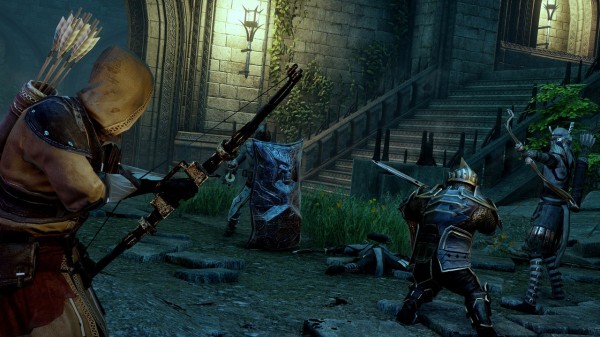
There are some changes in the combat system, as you’ll be limited to four skills (which can be changed between missions) and obviously, there will be no pause. Also, unlike Mass Effect 3 there will be no tie to the single player, which should make anti-multiplayer users very happy.
It really seems that Bioware thought of everything and everyone while creating Dragon Age: Inquisition; players will even be able to choose two different voice actors, one sporting a British and another an American accent. You should understand now why the game was our runner-up at Gamescom 2014 for Best RPG, beating many other promising titles in the genre and coming up just behind the massively anticipated The Witcher 3.
If everything goes as promised, we’ll have a great RPG on PS3, PS4, Xbox 360, Xbox One & PC due in November, marking the comeback of a legendary studio.