
The Wolf of Wall Street Review - Money Never Sleeps
The Wolf of Wall Street is the name of the autobiography of Jordan Belfort, a stock crook who reinvented himself as a motivator and an enterpreneur after two years spent in a federal prison. Leonardo DiCaprio strongly wanted this movie, and started to work on it back in 2007, but production stopped because of problems with Warner Bros. At last, Red Granite Pictures won the rights of the story, and Martin Scorsese was called back to direction, after a small bracket with Ridley Scott on the director’s chair.
The story begins in 1987: Jordan Belfort is a young and rampant worker who always dreamt of being a broker, but his first day of job ends up being the Black Monday. After losing his just achieved position, supported by his wife Teresa, Jordan gets hired by a small call center for financial counseling, specialised in “penny stock” (stocks with little or no quotation). From a small and meaningless job, Belfort creates an immense financial empire, the Stratton Oakmont, and gains the nickname “Wolf of Wall Street”. However, almost nothing of his patrimony has been legally obtained…
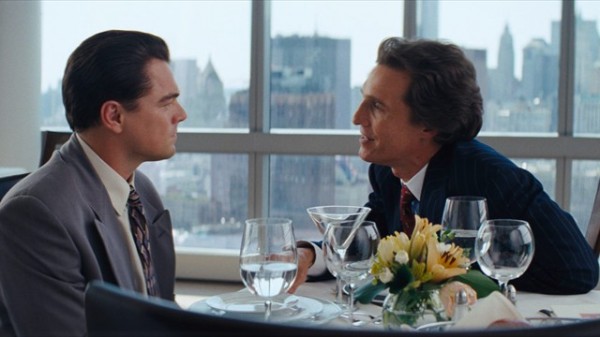
After Gangs of New York, The Aviator, The Departed and Shutter Island, The Wolf of Wall Street marks the fifth cooperation between the director, Scorsese, and the main actor, DiCaprio (this time also filling the producer role). Compared to his latest works, Scorsese abandons any hesitation and creates a brilliant and unbelievably nasty comedy that is a surreal farce about the world of Wall Street: between drugs, orgies, circus-like shows, rockstar attitude, a language that would make Tarantino blush (the movie breaks the record for “the most uses of the fuck word in film history”), cheatings and tricks, The Wolf of Wall Street brings the spectator in a world of profligate excess and total lack of respect towards human beings and legality; make no mistake, this is a world ruled by money only, in which the only driving force behind any action or thought is the desire to increase one’s capital.
DiCaprio gives a good performance, above the lines but controlled, a sort of carnival mask that is almost a caricature of Jordan Belfort’s behavior; the other actors are also great, even if more or less on the background compared to the protagonist: Jonah Hill, Rob Reiner, John Bernthal, Margot Robbie, Jean Dujardin, Joanna Lumley, Matthew McConaughey are all extras in the life of a man totally centered on himself. These characters are based on real people (although many names have been changed due to legal issues) who have been transient and secondary elements in Belfort’s life, including the wife, friends and colleagues, not to mention the clients and the “enemies” from FBI. The satire grows to embrace the entire social and juridical American system, which actually rewards rich people over the honest ones, and changes penalties and punishments depending on the bank account (even off-shore).
Scorsese directs the first half of The Wolf of Wall Street in a brilliant, easy-going, irreverent manner, going out of any logic or measure, winning over the public by luring everyone in Belfort’s mind; the second half, unfortunately, is affected by an abrupt drop in rhythm, with a couple of simply endless sequences (the one with hopped-up DiCaprio and Hill, for instance) and others in which the change in tone and genre isn’t justified by anything else in the movie (Belfort trying to take his daughter away from Robbie). Charged with representing the world of financial crook in too much a “sympathetic way”, The Wolf of Wall Street, on the opposite, obtains with satire what only Oliver Stone had achieved with his Gordon Gekko, bringing on the screen front page’s monsters and stories of ordinary folly, even if apparently tones are light and easy going.